
The One-Person Company | Ken's Startup Sandbox — EP01: I Started a Company in One Evening
No team, no finished product—just a new save file for a startup experiment.

The one-person company has been getting a lot of attention lately.
It's easy to see why. AI has changed the amount of work a single person can take on. Coding, prototyping, website building, research, design and repetitive business tasks are all more accessible than they used to be. Things that once required a small team can sometimes be started by one determined person with the right tools.
I wanted to find out how far that idea could go in the real world.
So, in October 2026, I registered ZYMEL PTY LTD in Australia. One director, one shareholder, no employees and—at the time—no finished product.
Why incorporate before building anything?
Because I don't see this as just another side project. I want to play entrepreneurship like an open-world game.
01 | A startup as an open-world game
I'm not launching ZyMel with a rigid ten-year plan and a promise that I'll never change direction.
I see it as a long-running sandbox: a place to experiment with software, data and AI, test ideas in public, and see what one person can actually build.
Maybe I'll launch a useful tool. Maybe I'll make an Android app, automate a workflow, or discover a completely different business model. Some experiments may attract users; others will fail quickly and teach me what not to do.
I'm curious how far I can take a company on my own with AI as a tool.
And if the company never turns into a great commercial success, I'll still have gained firsthand experience in product development, technology, marketing, accounting and the practical business decisions that books tend to gloss over.
I want to document all of it—the wins, the dead ends, the mistakes, and everything in between.
This is The One-Person Company | Ken's Startup Sandbox. Welcome to EP01.
02 | Why register a company before building the product?
The standard advice is to build an MVP, validate demand and incorporate later. That can be excellent advice. This time, I decided to reverse the order because a registered business opens up options that aren't always available to an individual.
A surprisingly practical example is publishing apps on Google Play. Google's rules say that personal developer accounts created after 13 November 2023 must have at least 12 testers opted into a closed test continuously for 14 days before applying for production access. For someone working alone, recruiting and coordinating 12 people is a real obstacle.
Organization developer accounts aren't subject to that particular 12-tester/14-day requirement for new personal accounts, although they still need business verification and must meet Google's app-review requirements. An organization account also generally requires a D-U-N-S number. So it's not a free pass—but it removes one specific hurdle.
There is also the wider startup ecosystem. Cloud providers, AI vendors and software companies offer startup credits, discounted services and technical support. Australia has innovation grants and programs worth exploring too. A registered company with its own domain and email makes it easier to establish a credible business identity when applying. That doesn't guarantee approval, but it creates more opportunities to try.
And eventually, if I work with business customers, having a company structure helps with contracts, invoicing, banking and separating personal and business activities. An Australian Pty Ltd is a separate legal entity, though limited liability doesn't eliminate every director's personal responsibility.
For me, incorporation was like creating the game account first so I could start exploring the map.
03 | What used to take a week took one evening—with AI as my guide
My old impression of setting up a company was simple: talk to an accountant, send paperwork back and forth, wait for responses, and allow about a week.
This time, I wanted to do it myself—with AI helping me understand each step.
To be clear, I didn't ask ChatGPT to magically register a company on my behalf. I completed the official government application myself. What AI did was make the research, terminology and decision-making far less intimidating.
First, I worked out the structure. I used AI to compare operating as a sole trader with forming an Australian Pty Ltd, to understand ACNs, ABNs and Director IDs, and to turn the official ASIC and government guidance into a checklist. A proprietary limited company seemed a better fit for a series of commercial experiments.
Next came the name. I went through variations including Zelym, Zyelm and Zymel, comparing pronunciation, memorability and domain options. I eventually chose ZyMel.
The name ZYMEL is inspired by the Ancient Greek zýmē (ζύμη), meaning leaven or yeast. I liked the idea of a small ingredient setting a larger transformation in motion. For me, it became a metaphor for what I want to build: AI and data acting as a catalyst of transformation, helping uncover value in information, ideas and everyday work.
That idea also gives the brand its direction:
Inspired by transformation. Built for intelligence.
以智能,发现价值。 — Using intelligence to uncover value.
When I checked the name during the application, the government site warned that it would be referred for a manual decision. I used AI to help interpret the message and understand that it was a review warning, not necessarily a rejection.
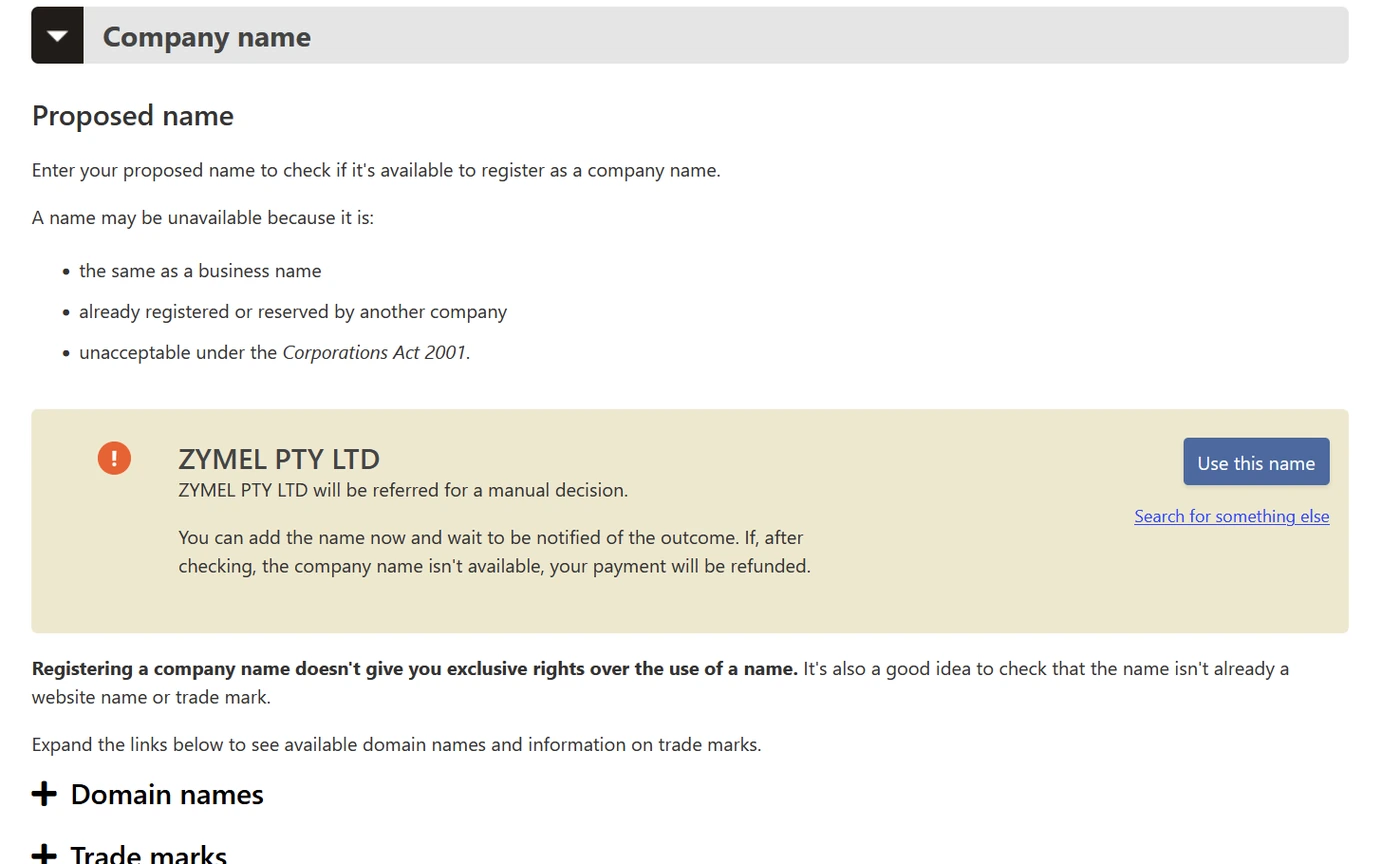
The real name-check screen. Not exactly the reassuring green tick I was hoping for.
Then I prepared the details. I already had my Director ID. I worked through the business activities, company addresses, directors and shareholders, and share structure. To keep things simple, I was the sole director and shareholder, with 100 ordinary shares at AUD 1 each, fully paid. Whenever a field was unclear, I asked AI what the wording meant and checked the answer against official information before making a choice.
Finally, I went through the Australian Business Registration Service page by page. I reviewed the company name, people, shares, and relevant tax choices, paid the fee and submitted the application.
It wasn't instantly finished. The company and ABN sections initially showed pending statuses.
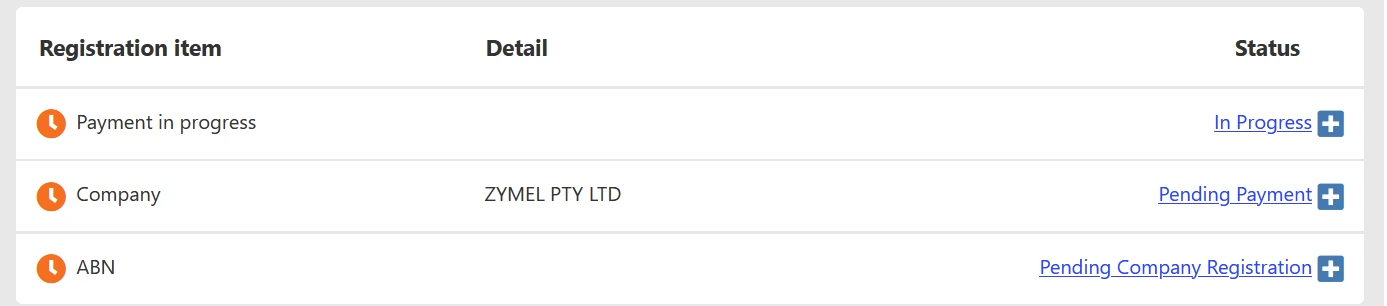
The original application-status screen, cropped to remove reference numbers and unrelated details.
The manual review was quick too. The company registration was completed the day after I submitted the application, and ZYMEL PTY LTD was officially registered. I also received its ACN and ABN.
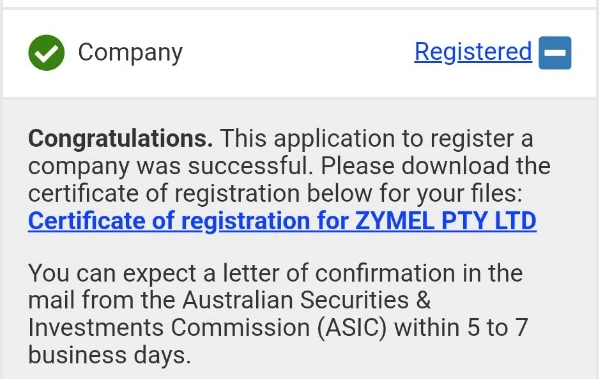
The moment the green tick appeared: Company — Registered.
The core research and online submission took one evening. Approval, number propagation, banking and tax administration were separate follow-up steps.
Compared with my old expectation of a week of accountant emails, the remarkable part was how much time AI saved on searching, interpreting and preparing. It didn't assume responsibility for my decisions—but it made it much easier for me to take them.
04 | The complications started after incorporation
First surprise: the banks didn't all recognize the new company at the same time.
I assumed a new ACN and ABN would appear everywhere immediately. Not so. In my experience, Westpac took roughly three days before its systems could recognize the newly registered company, while Commonwealth Bank (CBA) was ready to proceed almost immediately. Same business, very different onboarding experience. A missing new-company record at one bank doesn't necessarily mean registration has failed; sometimes it simply hasn't propagated through that bank's systems yet.
Second surprise: finding a good domain is its own project.
After choosing ZyMel, I discovered that zymel.com was already registered. That was fine: zymel.ai was still available at the time, and .ai fitted the AI products I wanted to explore. I also compared .com.au and .au, weighing price, brand fit and whether defensive registrations were worthwhile. In the end, I chose zymel.ai as the primary domain.
The domain wasn't the only thing that mattered. In my initial research, I hadn't come across an AI or IT company with the same name and a similar business. That made ZyMel feel like a name with room to grow into a brand. Of course, company names, domains and trade marks are different things; a formal trade mark application would still need its own searches and checks.
Third surprise: sending and receiving email for free takes a little engineering.
I wanted sales@zymel.ai without paying for a full business email suite from day one. My solution was Cloudflare Email Routing to receive and forward incoming messages, combined with Resend's free sending allowance and a mail client.
It works well enough for a low-volume solo project, but it isn't a conventional hosted mailbox out of the box. Receiving and sending are separate systems; SMTP, DNS records, SPF, DKIM and DMARC still need attention. Free tiers also have limits, and the domain itself isn't free.
Fourth surprise: a company comes with ongoing administrative quests.
I still need to maintain shareholder and director records, manage the company's TFN, set up relevant authorizations through RAM (Relationship Authorisation Manager), keep accounts and file taxes, and complete ASIC's annual review—including reviewing company details, paying the relevant annual fee and handling solvency resolutions as required. Whether GST registration and BAS reporting apply depends on the company's circumstances and registration obligations.
When you're the only person in the company, you are also the developer, product manager, accountant's liaison, support desk and office administrator. The side quests add up quickly.
05 | The startup perks I applied for—or started exploring
Part of the fun of forming a company early was seeing which resources a brand-new startup could access.
| Program | My status |
|---|---|
| Westpac Business One welcome promotion | Account opened; transferred AUD 100 of my own money on 9 October with the reference WELCOME100 to attempt the required deposit step. The bank’s bonus has not been confirmed. |
| Claude for Startups | Applied on 8 October using my business email; first application declined on 9 October. |
| Microsoft for Startups / Founders Hub | Researched and started the application process; no confirmed credit award to report yet. |
| AWS Activate, Google for Startups Cloud, Zeller for Startups | Exploring the programs and their requirements. |
| F6S, StartupCreds, FounderPass, Models & Makers, Australian and NSW startup grants | On my research list for future applications. |
One of the first offers I tried was Westpac’s WELCOME100 promotion. It asked eligible new customers to deposit at least AUD 100 with WELCOME100 in the payment description. I made that deposit using my own funds.
That's another useful lesson from the game: money I transfer into my own account is not startup revenue, and a potential reward isn't a received reward.
I'll record the rejections and unresolved applications as well. Not every loot box gives you something useful.
06 | What's next? Start with valuation, but keep the sandbox open

The field I know best is property valuation.
It's a natural intersection of my experience with data engineering and my interest in real estate. I want to explore how AI, property data and automated valuation models (AVMs) might support valuers, remove repetitive tasks or become useful software tools. Perhaps the first experiment will be a focused SaaS product. Perhaps it'll be something much smaller.
But ZyMel won't be limited to valuation.
This is a long-term sandbox. If something looks interesting and testable, I'll give it a shot: AI applications, developer tools, workflow automation, mobile apps, or ideas I haven't discovered yet. When an experiment doesn't work, I'll write down why and try something else. Useful code and lessons can carry over into the next round.
Of course, I still need to take care of the basics—company records and taxes, the website and email, operational compliance, prototypes and real user feedback.
Each episode in this series will track the idea, the build, what it cost, what broke, what I learned, and what happened next. Not just the victories.
Final thoughts | A game without a walkthrough
I used to think starting a company meant having an office, staff, funding and a fully formed business plan.
Now I'm trying a lighter version: one person, one company, AI as a toolkit, and the real world as the game map.
I don't know how many levels I'll reach. Maybe this becomes a real business. Maybe it ends up as a remarkably detailed collection of experiments that didn't work.
Either way, if I've documented the journey and learned something useful along the way, I won't consider it wasted effort.
ZyMel is my new save file. EP01 was about creating the company. We'll figure out the next level as we go.
Appendix | The online company registration checklist
If you're planning to register an Australian Pty Ltd, I've turned the full process into an online guide. It covers preparation, the BRS application, banking and tax setup, ongoing administration, a quick checklist and space for notes. Check off tasks and fill in records directly on the page; progress stays in your own browser, and you can print a copy too.
Open the Australian Pty Ltd registration & administration checklist →
Written in October 2026. This is a personal account, not legal, tax or financial advice. Images of official registration screens are genuine, cropped and sanitized to remove unnecessary identifying information.
References: Google Play closed-testing rules for new personal accounts · Google Play organization verification requirements · Cloudflare Email Service · Resend pricing · ASIC annual company review · Westpac Welcome Offer terms